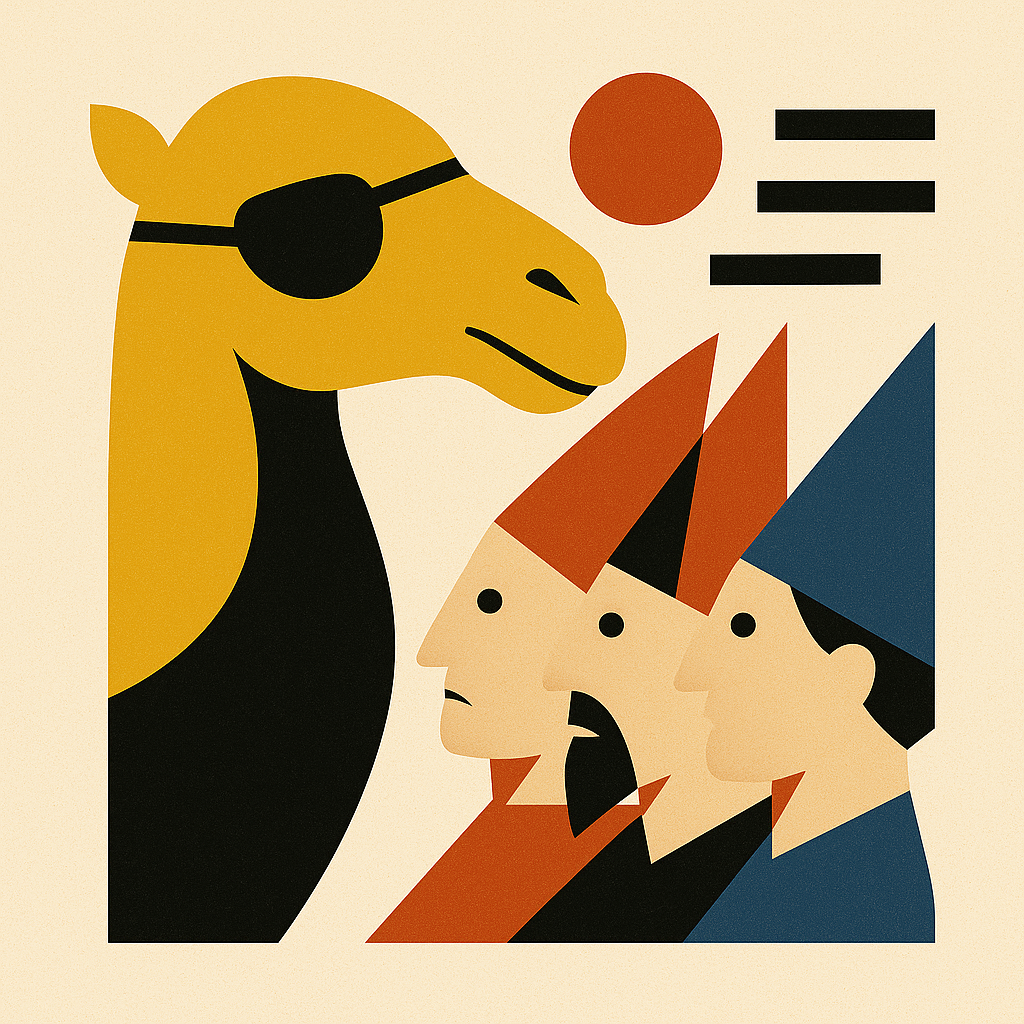
Once upon a time, in the land of Serendip, there ruled a wise and powerful king, Giaffer. He had three sons whom he loved very much, and he wanted to leave them not only his kingdom, but all the knowledge and virtues that the rulers of a great kingdom should have. So he gathered great scholars from all over his realm, each with a different specialty, and set them as tutors to his sons. The king bade each tutor to instruct the princes so well that any expert who encountered them would immediately recognize who their teacher was. And so the tutors did.
Because the princes were all highly intelligent, it took hardly any time for them to become experts in science and language and philosophy and all the other subjects that they studied, and soon they were far more knowledgeable than any other young princes or nobles of the same age and rank. The tutors returned to the king to report on how much progress the princes had made. The king was a bit skeptical that the princes could have gained so much knowledge so quickly, so he decided to test them.
Sending for his oldest son, the king said, “My son, you know how long I have ruled this kingdom, and how I have strived to take care of my subjects, and to rule them with love and mercy as well as justice. But now I’m getting old, and I feel that it’s time to me to focus on my journey to the next world.”
“So I have decided to retire to a monastery, to spend the rest of my days meditating and praying for my sins. You are my oldest son, and so to you I leave the kingdom. I ask that you rule with equal justice for all, governing with love and charity, especially for the poor and the aged and the sick, and that you punish the guilty and the wicked according to the laws of the land, and of God.”
The oldest son bowed down before his father and said, “Sire, while I understand your wishes, I know that you are still quite able to rule this kingdom well, and with God’s grace I pray that you will be able to do so for many more years. So while I am willing to obey you in anything, I feel that as long as you are alive and well, it would not be appropriate for me to take the crown. When, eventually, the Lord takes you to heaven, of course I will take care of the kingdom, and I will try to rule as wisely and justly as you have.”
The king was pleased with his son’s answer, which showed both wisdom and humility. But he hid his feelings and dismissed his son. Then he called his second son, and made the same proposal. The second son also refused, adding, “Shouldn’t my older brother be the ruler after you?” And the king hid his feelings again and called his third son, who also refused, reminding his father that his two older brothers rightfully came before him.
The king was satisfied that the princes’ tutors had taught them well, and that his sons would be good rulers of the kingdom after him. After contemplating the matter more, he decided that to complete their education he would send them out into the world, so that they would have real-life experiences in addition to the knowledge they gained from books and from their tutors.
You’d think he’d just say that to them, wouldn’t you? But no. Instead, he called his sons to him, and pretending to be angry, he said, “Because the three of you are disobedient and refused to obey my wishes, I am banishing you from the kingdom. Leave.”
Of course, the princes were shocked and hurt. But they loved their father, and he was the king, and so the three of them gathered some things and left the kingdom. They traveled on and on, until they reached another kingdom, ruled by a great emperor named Beramo.
As they journeyed down the road towards the imperial capital, they met a camel driver whose camel had run away. The camel driver asked the princes if they had seen his camel on the road. They hadn’t, but they had seen some camel tracks, and they were feeling mischievous, so they decided to pretend that they had seen the camel.
To make it convincing, the first son asked, “Was your camel blind in one eye?”
“Why, yes,” the man said.
“And was it missing a tooth?” asked the second son.
“Yes,” the man said.
“And was it lame, as well?” asked the third son.
“Yes!” the man said.
“Oh, then we’ve definitely seen it!” the brothers cried all together. “We passed it on the road quite a while ago.”
Overjoyed, the man thanked them and ran off in the direction that the brothers had come from. But of course he couldn’t find the camel. Trudging back the next day, he ran into the brothers again, resting by a spring of fresh water.
“You lied to me!” he said to them. “I backtracked over twenty miles along the road, and I never found my camel.”
“You heard the information we gave you,” said the first brother. “Judge for yourself if we were lying. And let me add, your camel has a load of butter on one side, and a load of honey on the other.”
“Also, it carries a woman on its back,” said the second brother.
“And she is pregnant,” said the third brother.
It was all true. This convinced the camel driver that the only way that the brothers could have known so much about the missing camel was if they had stolen and hidden it themselves. So the man went to the judge, accusing the brothers of having stolen his camel, and the judge had them arrested and thrown into jail. The next day, the emperor himself heard the case, and sentenced the brothers to death.
Camel in the courtyard caravanserai 1870 jpg Portrait
Luckily for them, a friend of the camel driver came across the missing beast wandering along the road, and returned it to its owner. The man went back to the court, and humbly told the emperor that he had found his camel, and the three men were innocent. The emperor had them released, and called them into his presence. He asked the brothers how they had known so many details about a camel they had never seen.
The first brother said, “I noticed that the grass had only been eaten on one side of the road, even though the grass on the other side was better quality. So I concluded that the camel must be blind in the eye facing the side of the road where the grass was good.”
The second brother said, “I noticed that the cuds of chewed grass were so large that they must have come out from the space the size of a missing tooth.”
The third brother said, “And I knew that the camel must be lame, because I observed the tracks of only three camel feet, along with the trace of a dragged foot.”
The emperor was astonished and impressed, and he wanted to know more. “How did you know the other details about the camel?”
The first brother said, “I guessed that the camel must be carrying butter on one side and honey on the other, because on one side of the road I noticed a trail of ants, who love fat, and on the other side I noticed a great number of flies, who love honey.”
The second brother said, “I guessed that the camel was carrying a woman, because at one point I saw marks indicating that the camel had knelt down, and nearby I saw a small human footprint, either a woman or a child. There was urine nearby, and when I wet my fingers in the urine and smelled it I felt a stirring of lust, so I was sure that the footprint must be that of a woman.”
The third brother said, “And I guessed that the woman must be pregnant, because I saw handprints, indicating that the woman had to help herself up with her hands after urinating.”
The emperor was so impressed with the brothers’ cleverness and observational skills that he begged them to stay as his guests. He provided them with the best rooms in the palace, and every day he would entertain himself with them, discussing a variety of different topics and enjoying their intelligent conversation.
And so the princes stayed with the Emperor Beramo for a while.